Industrial Display Technologies: A Guide to Professional Video Wall Systems
Professional video wall systems designed for control rooms, crisis centers, and corporate lobbies, including frame thicknesses, matrix processors, and installation engineering guidelines.
Professional Video Wall Systems and Industrial Use Cases
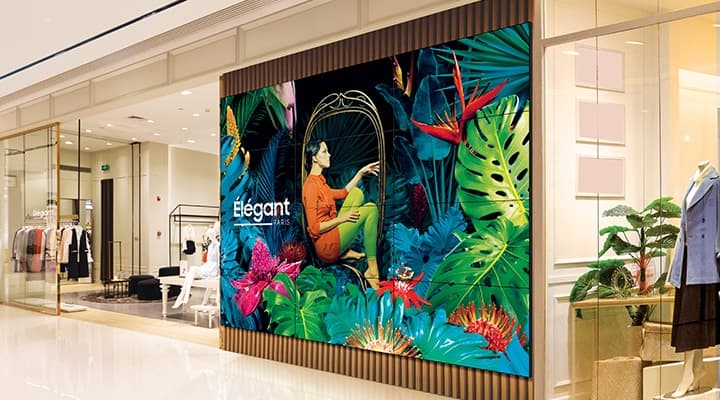
Representing the highest and most complex segment of industrial display technologies, Video Wall Systems are massive visual walls created by combining multiple professional monitors in a specialized matrix configuration (2x2, 3x3, 4x4, 5x5, or asymmetrical as needed) side-by-side and stacked on top of one another. Capable of functioning as a single, homogeneous large screen, these systems are used in are designed to provide a seamless, high-resolution, and real-time flow of information in security monitoring centers (NOC/SOC), logistics operations rooms, crisis management areas, broadcast studios, financial data centers, and prestigious corporate lobbies.
Unlike traditional home or standard commercial televisions, these systems—which stand out for their near-zero bezel thickness, hardware-based color calibration capabilities, and seamless signal management—maximize operational efficiency by visualizing businesses’ decision-making processes.
4 Critical Engineering Parameters That Determine Success in Video Wall Projects
Unlike ordinary screen拼接 setups, the fundamental hardware and software standards that determine system stability and image continuity in an enterprise-level multi-screen project are as follows:
1. Ultra-Thin Bezel-to-Bezel Technology
The total thickness of the two black lines formed between screens when they are joined (Bezel to Bezel) is the most critical factor for image integrity and readability. Especially in control rooms where maps, small text, financial charts, or IP camera feeds are viewed, a thick bezel can result in the loss of critical data. In professional projects, bezel thicknesses are selected according to the following standards:
- 3.5 mm (Standard Bezel): A cost-effective solution typically used for in-store advertising walls and digital menu board systems viewed from a distance.
- 1.7 mm / 1.8 mm (Slim Bezel): Provides ideal visual continuity for corporate lobbies, conference rooms, and mid-sized data monitoring centers.
- 0.88 mm (Extreme / Ultra Narrow Bezel): A premium standard preferred in top-tier control rooms, crisis management centers, and military operations centers to minimize visual disruption caused by bezels to zero.
2. 24/7 Uninterrupted Operation Performance and Panel Type
Screens in security monitoring, logistics, and production control rooms must operate reliably 24/7, 365 days a year, without ever shutting down. Consumer-grade televisions (Consumer TV) cannot withstand this pace; their panels are prone to rapid overheating, color fading, and a defect known as “screen burn-in” (burn-in / ghost image), where static images become permanently etched onto the panel surface. Professional video wall displays are equipped with industrial IPS or vertically aligned (VA) panels that offer high thermal resistance. These panels feature specialized designs that prevent the degradation of the liquid crystal structure.
3. Panel Calibration and Color Uniformity (Chroma Calibration)
Even when screens of the same brand and model are used, each panel’s factory-set color output and brightness curve (Gamma) may vary by microns. Over time, as panels age, this discrepancy widens, causing some screens on the wall to appear more yellow and others brighter, which compromises visual aesthetics. Professional systems utilize both hardware and software calibration mechanisms. With the help of specialized spectrometer cameras, the RGB color coordinates and brightness values (in nits) of each panel on the video wall are measured. With the help of the background processor, a uniform white balance and color uniformity (90%+ accuracy) are permanently maintained across the entire wall.
4. Video Wall Controller (Processor) and Matrix Signal Management
The brain of the system is the powerful hardware-based Video Wall Controller (Video Processor) unit operating in the background. The processor receives and processes incoming signals from multiple sources (PC, IP camera, media player, live TV) and distributes them to the video wall without losing any pixels. Thanks to advanced matrix software, the video wall can be managed with complete flexibility:
- Single Screen Mode: A single large 4K/8K video or presentation graphic can be played across the entire wall.
- Multi-Window (PIP/POP) Mode: Screens can be divided into independent pixels via software. For example, while a map scrolls across the four screens on the left, 16 different security camera feeds can be displayed live on the screens on the right.
- Scenario Management: With a single button press, you can switch between pre-recorded screen layout scenarios—such as “Crisis Mode,” “Normal Operation Mode,” or “Presentation Mode”—in a matter of microseconds.
Mechanical Mounting Engineering and Micro-Adjustable Mounting Systems
In video wall projects, the mounting system is the most critical element—one that is often overlooked during budget planning but directly determines the success of the installation. Ordinary fixed TV mounts absolutely cannot be used in professional projects. In multi-screen walls, micro-adjustable (6-axis) Push-In/Push-Out (Push-Open) specialized hydraulic mounting systems must be used for each panel.
This mechanical engineering offers your business two vital advantages:
Flawless Alignment: By ensuring millimeter-precise alignment of the screens along the depth, height, and left-right axes, it achieves zero elevation difference between screens (a completely flat wall).
Front-Service Accessibility: If a technical malfunction or loose cable connection occurs in a central screen, there is no need to dismantle the entire wall. When light pressure is applied to the faulty panel, the hydraulic mechanism pushes the screen forward. This allows for technical intervention within seconds without damaging the other screens.
Frequently Asked Questions About Video Wall Systems
Below, we’ve provided detailed answers to the technical and operational questions most frequently asked by organizations, IT managers, and architects during the planning phase:
- How are video wall prices determined, and what are the actual cost components? In video wall projects, the cost is not limited to just the price of the screens. The total budget depends on the size of the screens (46" or 55"), the bezel thickness (0.88 mm to 3.5 mm), the brightness level (500 nits – 700 nits), the number of inputs/outputs on the controller hardware to be used in the background, micro-adjustable mounting brackets, steel structure fabrication, and professional calibration labor.
- How should the brightness level (nits) of screens be selected? A brightness value of 500 nits is more than sufficient for standard control rooms and indoor spaces without natural light. However, for lobby areas or studios located near glass facades with direct, high-intensity lighting, panels with anti-glare properties (28%–44%) and a brightness of 700 nits should be preferred.
- How is the system protected against power outages and fluctuations? The power supply lines for industrial video wall systems must be configured through uninterruptible power supplies (UPS) and voltage regulators. Additionally, thanks to smart power management units, the screens are automatically turned on in sequence (with a delay) in the morning, preventing sudden high current draw (inrush current) from the grid.
- Do Video Wall control software solutions integrate with existing IP camera (VMS) systems? Yes. Our modern control systems can be fully integrated via API with leading video management software (VMS) such as Milestone and Genetec. This allows the live feed from the relevant camera to be automatically displayed on a massive screen on the video wall when an alarm is triggered.
Turnkey Professional Solutions at Koz Teknoloji
As Koz Teknoloji, one of Turkey’s leading integrators in corporate AV and high-tech display systems, we provide end-to-end turnkey engineering services—from crisis management centers to control rooms, and from prestigious corporate lobby spaces to broadcast studios. With our team of technical experts, we ensure the security of your operations through static load analysis, architectural surveys, steel structure fabrication, hardware procurement, 6-axis precision calibration, and uninterrupted 24/7 post-sales technical maintenance. To explore our projects for robust and long-lasting video wall systems that will strengthen your corporate identity, receive technical specification support, and get a customized price quote for your business, please contact our professional engineering team today.