
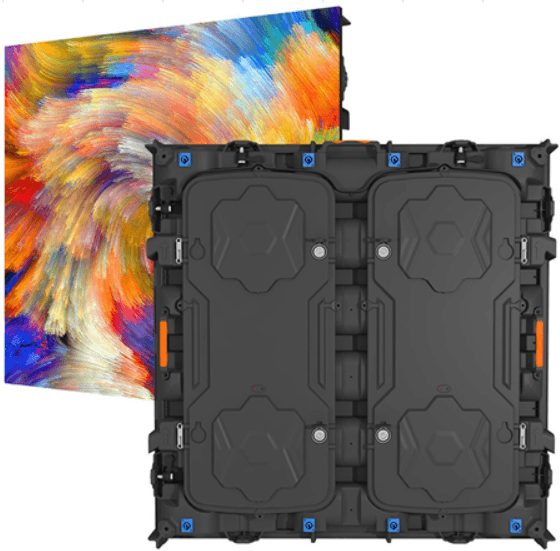
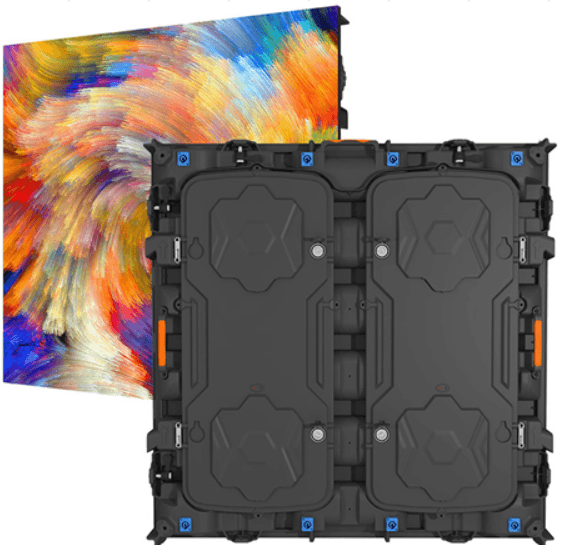
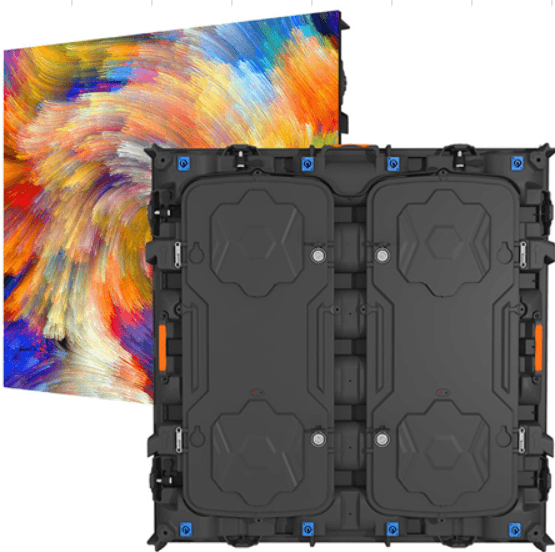
What is an outdoor LED screen?
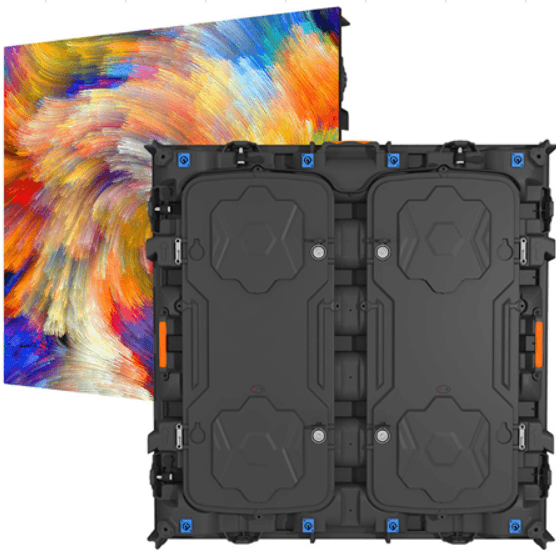
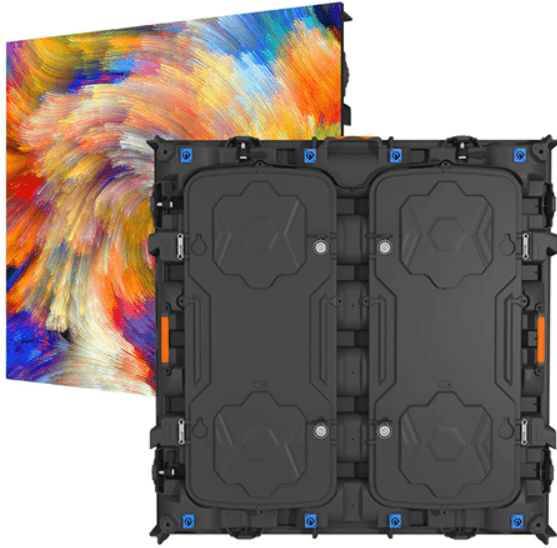
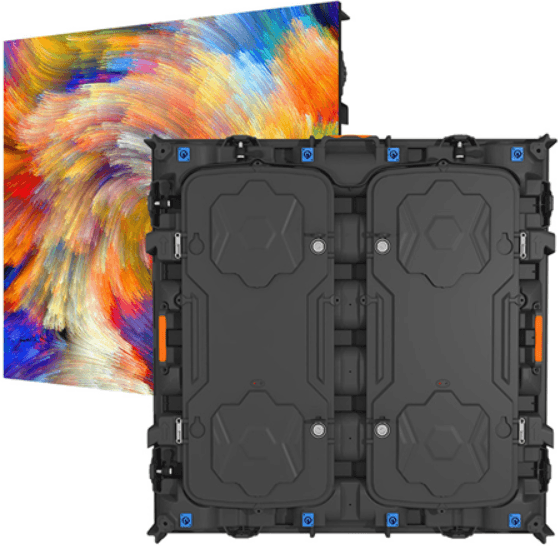
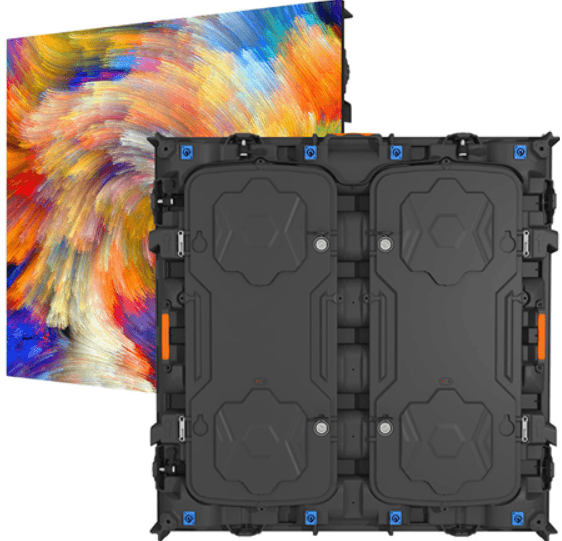
An outdoor LED screen is an LED display built bright enough to be read in sunlight and installed in cabinets that withstand rain, dust and temperature changes. Modules are fixed in cabinets and the cabinets to a support structure, forming a surface of the required size on a facade, entrance, square or roadside. The models on this page range from P2.5 to P10, are built with 960 × 960 mm cabinets and, according to the product data, have a brightness of 3,500-5,500 cd/m². Indoor models are 350-550 cd/m², which is not enough in daylight.
Pixel pitch by viewing distance
We use the same rule as our LED display calculator: the closest viewing distance in metres is roughly the pixel pitch in millimetres, and comfortable viewing starts at about 2.5 times that. Outdoors the viewer is usually far away, so wider pitches are enough; where pedestrians pass a few metres in front of the screen, the pitch gets smaller.
| Pixel pitch | Closest viewing | Comfortable viewing | Brightness (cd/m²) | Cabinet resolution (960 × 960 mm) | Typical use |
|---|---|---|---|---|---|
| P2.5 | 2.5 m | 6.3 m and beyond | 3,500-4,000 | 384 × 384 | Pedestrian areas, entrances, shop fronts |
| P3.07 | 3.1 m | 7.7 m and beyond | 3,500-4,000 | 312 × 312 | Facades and squares viewed from close up |
| P4 | 4 m | 10 m and beyond | 4,500-5,000 | 240 × 240 | Building entrances, campuses, sites |
| P5 | 5 m | 12.5 m and beyond | 4,500-5,000 | 192 × 192 | Street facades, car park entrances |
| P6.67 | 6.7 m | 16.7 m and beyond | 4,000-4,500 | 144 × 144 | Building facades, outdoor advertising |
| P8 | 8 m | 20 m and beyond | see product page | 120 × 120 | Facades, car parks, long-distance viewing |
| P10 | 10 m | 25 m and beyond | 5,000-5,500 | 96 × 96 | Roadside, sports grounds, very long distance |
Example: the 10 × 6 metre P6.67 facade screen in the calculator gives a resolution of about 1500 × 900 pixels and is comfortable to watch from 16.7 metres. If the same facade faces a footpath and the closest viewer is 7 metres away, P2.5 is needed; the number of pixels per square metre rises sevenfold and the cost rises markedly with it. That is why during the survey we first measure where viewers look from.
Brightness: why 3,500 cd/m² and more outdoors?
Daylight falls on the screen and lowers its contrast. The 350-550 cd/m² that is enough indoors washes the picture out on a facade in midday sun. The direction the screen faces, how many hours of direct sun it gets and whether anything shades it determine the brightness choice. Facades in direct sun call for the upper end of the range; under eaves or in semi-enclosed areas a lower value can be enough.
At night the same brightness is a nuisance and wastes energy. During commissioning we set brightness to adjust automatically to ambient light or time of day.
What does the IP protection class mean?
The IP class (IEC 60529) has two digits. The first shows protection against dust and the second against water. In IP65, 6 means dust-tight and 5 means protected against water jets from any direction; IP54 means partly protected against dust and protected against splashing water. Manufacturers may give separate classes for the front face and the rear cabinet. A screen fully exposed to the weather does not have the same needs as one under eaves. We state each model's protection class from the manufacturer datasheet in the quote.
Support structure, power and service access
- Structure: A steel structure is designed from the screen's weight and the wind load. On high facades this is the most critical part of the installation.
- Permits: Facade and roadside screens may need permits from the local authority and building management; the schedule is planned around them.
- Power: The supply line, panel location and earthing are planned in advance. Consumption figures in the calculator are rough estimates; we take exact values from the chosen module's datasheet.
- Service access: Whether the modules are reached from the front or the rear is decided at the start. For screens mounted high up this decision directly affects maintenance cost.
- Control and content: The screen is fed through a control system; content can be updated remotely and brightness scheduled.
Where is it used?
- Building facades: Corporate visibility and announcements. The support structure and facade permits make up much of the installation.
- Building, campus and site entrances: Welcome, wayfinding and announcements; viewers are close, so P2.5-P4 is the usual range.
- Billboards: Viewed from a distance at the roadside; a wide pitch and high brightness are enough.
- Sports grounds and car parks: Scoreboards, information and wayfinding; durability and easy service come first.
What determines the price, and how is a quote prepared?
Price depends on surface area, pixel pitch, brightness and protection class, and the support structure; height and difficulty of access change installation cost considerably. The items are explained in our article on LED screen prices. Share the installation site, the approximate screen size, its height above ground and the closest viewing distance, and we will price several pitches side by side, structure and installation included. For project scope see LED display solutions, and for enclosed spaces indoor LED displays. You can reach us via our contact page.
Frequently asked questions
Which pixel pitch should I choose for an outdoor LED screen?
Divide the viewer's closest distance from the screen by 2.5; the result in millimetres is the largest pitch for comfortable viewing. On a facade where the closest viewer is 17 metres away that is 6.8 mm, so P6.67 in the list fits; at 10 metres, P4.
How many nits should an outdoor LED screen have?
The models on this page range from 3,500 to 5,500 cd/m² (nits). Facades in direct sun need the upper end of the range; screens in shade or under eaves can manage with the lower end. We assess the screen's direction and sun exposure during the survey.
What does IP65 mean?
In IP65 the first digit (6) means dust-tight and the second (5) means protected against water jets from any direction. Outdoors, the classes the manufacturer gives for the front face and the rear cabinet are checked separately.
Is a permit needed to install an outdoor LED screen?
Screens on building facades and in public areas may need permits from the local authority and building management. We clarify the permits needed for the site together at the start of the project.
What information do you need for a quote?
A photo of the site, the approximate screen size, its height above ground, the closest viewing distance, the direction it faces and what will be shown. With this we price the pitch options including the support structure.